Tuesday, 28 September 2010

I cus you cus we cuss about couscous..

Cous Cous

I've never really given a lot of thought to couscous, it was always what got served at lunch time in cafeterias when I was on French exchanges. At home, it never really featured, not when there were potatoes, pasta, errm more potatoes, bread and numerous other starches that could bulk out a meal.
I'll accept that I might have had a slightly sheltered childhood, but it wasn't really anything that bothered me.
Several years ago I took a trip to Morocco with my sister, the Tagines we had were beautiful, the interesting grilled meat street foods were glorious, but according to all the Moroccans we spoke to, Berber couscous was the thing.
Annoyingly the chap in question who was most forthcoming in his praise for Berber couscous was also quite forthcoming in his praise for my sister, and after a while became quite insistent that we should come with his to dine on his mothers evidently supreme example. To cut a longish story short, we made a swiftish exit.
Since then I might have been a bit harsh on the food stuff. On occasions going so far as to state that with the amount of flavourings one needs to make couscous nice, you'd be as well cooking cardboard.
However I have been wrong before, and I'm pretty certain I'll be wrong again (though if you could refrain from letting people I used to work with this little fact, I'd be most grateful).
So when I was invited to travel to Sicily to attend a couscous festival in San Vito lo Capo near to Trapani I jumped at the offer (and it wasn't just because there was a pretty girl doing the offering). We'd left Trapani airport in the morning and set off to the rental house that had been organised near to Marsala. Not having any real clue as to the geography of the region I didn't really give this much thought. I'm used to being driven round on wine trips, so I tend to relax into a sort of beautific state of nonchalance regarding directions and the proximity of one place to another. After a journey to the beach where we trekked across a shallow bay to find an out of the way beach near to a disused saltworks for a swim and clamber over salt mounds we were all feeling a mite pekkish. Showers were had and we all clambered into cars. My ears pricked up a little at the mention of 60km! Surely we were on an island, how could we be that far away? Apparently that was 60km as the crow flies. A lengthy car ride up into the hills outside of Trapani snaked through imposing rocky crevasses, with looming mountainous shadows ominously following our journey. Signs started to point away from Trapani, then oddly enough started to point back towards Trapani. What was going on?
Then it became obvious, out of the window I saw a sign announcing that we were just leaving Purgatorio.... well that expained everything.

Parking just outside of the town, we followed the crowds and wafting scents of cooking towards the festival. Entry was free, though if you wanted to eat you had to buy some tickets, not really speaking Italian I didn't quite understand what the various tickets entitled us to, anyway for 10 euros each we were entitled to a bowl of couscous, a glass of wine and a portion of a sweet thing. Now I know that couscous is an expensive commodity but even so I did raise an eyebrow.
The festival was broken down into numerous tents, Couscous from Italy, global couscous, organic couscous etc, with other little tents showing off regional specialities like Vodaphone and a couple of local wine merchants.

I tried, I really did. There was a lovely bustling atmosphere, music and lots of people having fun. We worked our way through a whole host of different bowls of couscous, there were lovely bits of Bison meat on the bone in a couscous con moutone con zucca grane, and the couscous con pantesca had a nice healthy whack of flavour and lots of mixed vegetables with fish. My favourite come the end of the day way the Pece scogghiu which married chunks of mixed rock fish with a slightly spiced and cinnamon inflected body, but nothing really thawed my cold un couscous loving heart. I just don't understand it, the texture, even when light and fluffy just seems designed to bulk other things out. Maybe I'm doomed to dislike what is obviously a foodstuff loved by the rest of the world, but I can't pretend that my favourite moment of the night was sitting down for a beer afterwards.

Hey ho, hey ho, it's off to Heimann we go


Zoltan Heimann cuts an impressive figure, tall and powerfully built his close cropped white hair and beard separate him from the crowd. Garrulous and endlessly quotable, he has dragged the region of Szekszard into the Hungarian wine scenes limelight. Not only has he galvanised an whole group of younger growers but he's also made some pretty fabulous wines.
Trying to taste wine and talk with him at the Buda wine festival is an exercise in patience as almost every other person walking by has to stop to chat. Every now and again he'll put a bottle on the table and whisper apologies, it's the head of the national bank or some other notable that he just has to have a quick word with.
Occupying slightly less of the limelight is Agnes his wife, no less imposing, though slightly quieter, this is very much a two person team and any time spent with the both of them reveals a couple, both focused and dedicated to their soil and land.

The Heimanns have roughly 40 ha of vines with a very interesting selection of varietals. Zoltan explains, it's their duty to revivify the region, and this means sorting out the plantings. Along with Kadarka, they have Merlot, both Cabernets, Kekfrankos, Syrah, and experimental plantings of Tannat and Sagrantino.

Large portions of their vineyard has been replanted, with more in the planning stages. They're vineyard land is comparatively well consolidated being in 2 main groups, most of it visible from their house on the top of the hill. They have plantings on the highest of the Szekszard hills, with the 290 metre marker lying in the block of 'French Merlot' which goes into their top cuvees. The choice of Tannat and Sagrantino as experimental plantings has been quickly justified as anyone who's been lucky enough to taste Franciscus or their Barbar blend will tell you, both varietals combine well with the existing stock adding respectively, an exotic bitter cherry, herbal and medicinal core to some silken Cabernet Franc, and as tight earthy tannic heart to a blend of the regions other grapes.
As for the indigenous grapes, the Heimanns have been at the forefront of the search for better clonal stock for Kadarka, a grape with which they regularly make very seductive wines.

Zoltan was elected president of the growers association some five years ago, at the time there was a degree of resilience to the appointment, though this was mainly from the older growers, who hadn't quite come to terms with the change in focus needed to prosper in the modern world of wine. His first tenure has been a great success with the number of growers bottling their own wine going from around 50 to close to 200, and a much more organised and cooperative approach to marketing the region (anyone who's followed Hungarian wine marketing will know that organised and cooperative are words rarely found in the same paragraph as marketing).

My visit to the winery coincided with possibly the worst vintage of the last 20 years, blame has been tentatively laid at the foot of the Icelandic volcano that erupted in early May, with the theory being that the ash clouds that covered Europe caused major climatic changes, particularly to the central European basin, Hungary, the Czech republic and many other central Eastern European countries have all experienced very cold and incredibly wet summers. Speaking to growers across the country the rough figure quoted is 50% loss of crop, though obviously there are small growers who have fared much much worse. In the case of the Heimanns, they have no Kadarka this year, nine tenths of the crop was left on the ground, and that which was harvested was so low in sugar and phenolic ripeness to be relegated to their siller wine. The later harvesting varietals, whilst still healthy are in need of a good month of extra sunshine. This doesn't look like it will be forthcoming.

Resilience is built into the Heimann DNA, that and starting things from scratch. Zoltans great grandfather was blinded just before the end of the great war, returning home to try and rebuild his life, he was further crushed by the great depression of the late 1929/30. After weathering the economic storm, he and his son were then pulled into the maelstrom of the second world war. Zoltan's grandfather was drafted to fight on the eastern front at the age of 41. After spending some time at the receiving end of Russian hospitality he finally returned a mere 48k. He was the same height as Zoltan (they are a tall family), the strains of being a prisoner of war led to him suffering several debilitating cancers including that of the colon, and needing a bag fitted. Zoltan's father was only 15 when his fathers death forced him to take over the estate. This was during the communist era, when times resolutely refused to improve for Hungary. However he rose to become president of the local cooperative. The collapse of Communism didn't really improve matters for the Heimanns, as the state ownership of the land had stripped them of most of their estate. So from the ½ a hectare that his father had saved they were forced to repurchase all their land at market values. Zoltan and his wife Agnes, then had the unenviable task of replanting, stripping promising sites bare and replacing the vines with more suitable varieties. Their constant forward vision has resulted in a winery and estate the will hopefully break the chain of hardship. Indeed the winery is set up with a view to being converted to gravity controlled flow should his son desire to install it.

The Heimanns make several ranges of wines, from an easy drinking beaujolais style early release that is pretty much solely for the Hungarian market through to some very top end cuvees that are extremely low production and stay in the cellar to be given to friends and family (there are perks....).


Viognier plantings
Wines:
Viognier 09, steel tank and no malo to improve crispness. Very fresh almost apples and pears on the nose with a very crisp and clean palette. A very modern wine.

Fuchsli 09, this is a Siller wine, which is a German/middle European style of very dark rose. It's made with Kekfrankos and Kadarka and has lots of strawberries and cream characters on the nose with darker red fruits making an appearance on the palette and a little lick of tannin an the finish. Zoltan claims that making the siller wine style is help it stand out in a crowded rose maket, but I suspect it's more to do with the more intense rose working better with soda water for spritzers...

As for their Kekfrankos plantings, like most of the region they have quite a bit, though their most promising vineyard was purchased in 2005 in a very bad way, with roughly 40% of the vines missing and the rest very overgrown. However they were so impressed with the quality of the fruit that they decided to cut the vines right back to the stumps and let them re-establish themselves from water shoots. Right now the vines have their first crop since regrowing, which is heavy as the Heimann's didn't want to put the vines through the trauma of crop thinning just as they were coming back to health.
The 08 showed violets, smoke, spice with cassis fruits and stewed plums on the nose, on the palette it had an interesting combination of medium plus tannins and a lean austere yet almost exotically spiced fruit.
Tasting the barrels of Kadarka in the cellar, it was very instrumental looking at the increasing intensity of the fruit character as we moved up through the quality scale. The top end wines, which go into the top blends, are stunning, showing a great consistency of palette concentration and oodles of dark spicy fruit.

The Heimanns have quite a lot of Merlot planted, with their “French” clones planted in some of their best vineyard sites, indeed it is Merlot that occupies the highest plantings in Szekszard.
The wines go from textbook plummy and sweet fruited varietal examples, to serious opulent and full bodied examples that would challenge in many a blind tasting challenge. Indeed one of the highlights of my visit was tasting 3 different barrels of their top Merlot, which is earmarked for a tete du cuvee blend to ba called Agnes (in honour of Mrs Heimann). The Taransaud new oak showed lots of sweet oak characters and lush fruit, where as the Vicard was much less aromatic but demonstrated a more consistent length and more body on the palette. Finally a Hungarian barrel from Kadar demonstrated a slight rusticity and unrulyness. I'm very excited to see how this wine will end up.

Syrah 07, a warm year this and with a touch of bottle age to the wine this now shows a chocolate and plummy nose, a nice earthy leathery bent ahile on the palette it's full flavoured, though a little hot. According to Zoltan the best Syrah is a bit like a pretty 18 year old Gypsy girl who's not washed for a week, sexy but at the same time quite disturbing...
The 2008 which is from a cooler vintage was very different. Crushed black pepper lurking around inky dark fruit, a gorgeous creamy ever so slightly medicinal (think camphor) palette with just the slightest hint of earthiness at the finish.
The 09 from barrel was different still, showing meaty leathery dark fruit. Much closer to a Barossa archetype than the Hawkes Bay that the 08 resembled.

Heimanns top wines are their blends, these are the ones that I feel really show off the potential of Szekszard as a world class region.

Britokbor 07 (50 % Cab F, 30% Merlot and 15% Kekfrankos, plus some other stuff)
This showed a rich and ripe nose taking in sour dough bread, violets, cherries, crème de cassis, a hint of raisins, then on the palette loads of dark cherry fruit with an earthy, meaty and complex long finish.

Heimann Barbar 07 – (equal parts Merlot, Tannat, Cabernet Franc with 10% Kekfrankos) this is a wonderfully earthy, ferrous little beast of a wine, sweet red berried fruit, lots of ripe tannins, and then it opens up to reveal violets and spice.

Tannat grapes
100% Tannat, called Stilusgyakorlat (roughly translates as experiment in style, a bit like RWT). This is a 15% monster, intense and creamy with loads of dark fruit and licorice, a nice medicinal edge and a palette oozing dark fruit, minted coffee and licorice. Interestingly enough the tannins, though huge, are extremely ripe. Similar, though not the same, as the top Bodegas Juanico tannats from Uruagay.

Franciscus 07, a blend of 2/3 Sagrantino, with 1/3 Cabernet Franc. A wonderful spicy herbal medicinal explosion on the nose, with an edge of big dryish tannins that is mollified by the creaminess of the Cab Franc. Quite unique and very good.

Franciscus 08 (from barrel) the blend is reversed this year to 2/3 Cab Franc and 1/3 Sagrantino, and consequently the dominant character is the violet scented dark berry Cab Franc fruit, but with a lovely polish of medicinal and slightly bitter sweet herbs.

Wednesday, 22 September 2010

Trapani - and a short breather

I'm currently in the beautiful, if quiet and out of season old town of Trapani, on the westernmost tip of Sicily. It's very beautiful with worn stucco frontages and everything in a muted pinkish or yellow ochre. It's warm, though a little muggy, and pretty much perfect to enjoy a coffee or two whilst reading Tomasi di Lampedusa's excellent "the Leopard".
Friends are arriving tomorrow at which point we will all decamp to a rented houses somewhere and I'm sure a small amount of food will be eaten, followed by the odd glass of wine..

Sunday, 19 September 2010

How we roll in Szekszard country


Szekszard is in the far south of the Hungary and lies about 10km from the Danube, the region itself is really a series of small hills (290 metres being the tallest) and the valleys that interconnect them. The soil tend to be deep loess, occasionally reaching depths of 30/40 metres. This is red wine country, the richness of the soil makes it hard to retain the acidity in the white grapes.

The town itself is a charming little place with a long history. The Romans brought viticulture to the region, and by the 11th century it was important enough for Bela I to found a Benedictine monastery (for the early Christian kings the network of monasteries were an essential part of the modernisation and civilisation of the country), the remains of which can still be seen. The town lies at the foot of the hills, and a short drive is enough to have you in the heart of the region. It's a very friendly and human sized landscape. With houses dotted between the vines, indeed one of the problems the region suffers is the proliferation of hobby growers, small patches of vineyards tended at the weekends by increasingly elderly growers, as the younger generation shows less and less interest in spending their weekends pruning, these are falling into disrepair, particularly problematic as in worse years they are a disease reservoir creating problems for growers nearby. The other issue is that many have small buildings and sheds nestled in the rows. This makes it hard and quite expensive to integrate the vines into larger and better managed holdings.

Viticulturally the region is quite diverse, as mentioned earlier the bulk of the plantings are red varietals, though of the whites Olaz Riesling is the most planted, and I have had nice examples of both Viognier and Czersegi Fuszeres (not a varietal I can see succeeding in the UK market).
Of the reds the traditional Hungarian varietals are Kadarka, Kekfrankos (the same as Blaufrankish from Austria), Zweigelt, and there's some ill advised plantings of Blauburger (a Kekfrankos x Portugeiser) a high yielding and pretty bland crossing. Then there are the international brigade. These are mostly Bordelais varietals, Cabernet Franc leads the pack, with many excellent examples demonstrating that it may well have found a home from home here in southern Hungary (what is it about the Loire getting usurped qualitatively with its prize varietal possessions, it's a bit like the English with sports.... bring them international renown then sit back and watch other countries do them better). There are extensive Merlot and Cabernet Sauvignon plantings too, all three of which are considered classic varietals for the region. Finally some of the more forward looking growers are experimenting with Syrah, and in one case Tannat and Sagrantino.

Like most of Hungary the transition from the Soviet era mindset hasn't been without problems, however the region has been blessed with the irrepressible Zoltan Heimann, currently president of the growers association, which under his leadership has seen the number of growers bottling for themselves grow from about 50 to nearly 200. The Heimanns have been instrumental in raising the quality and renown of the region, and I'm pleased to say that they show no real inclination to stop, further more their son Gabor has recently graduated from Geisenheim and is currently in Tuscany broadening his view of the international wine world.

There are a core of growers that are producing serious wine which stands up very well against international competition, the largest of these would be Takler, though Esterbauer and Vestergombi deserves mentions too. Finally and possibly most interestingly there are a couple of young smaller growers who are generating a lot of excitement with their wines. Csaba Sebestyen and Miclos Palos, though approaching their wine making from slightly different angles are both producing exceptional wines that deserve to be sought out and seen by a wider audience.

Sadly, my time in the region has coincided with possibly the worst vintage of the modern period. Hail in the summer left the vines damaged and rot prone, warm and damp weather sent peronspora raging through the vineyards, often giving growers less than a day to respond, those that hesitated or didn't have good enough canopy management suffered very large crop losses. Frustratingly the well aerated canopies that were necessary to avoid mildew problems also meant that there wasn't that much in the way of leaves, which in turn has meant for many growers what they are harvesting is of a much lower must weight than desired.

The sole mitigating factor is that in the cellars, shielded from all but the most dedicated drops of water there are barrels of the 2009 to taste. 09 was a stunning year for Szekszard, with the only problems was that sugar levels shot up at the end of the summer giving wine makers like Agnes Heimann all sorts of headaches as must weights needed lowering just to get the fermentations started. Indeed Ferenc Takler had to use Veronese yeasts for his Cabernet Sauvignon, only yeasts trained up on Amarone levels of sugar were going to cope and last the distance to the 17% final alcohol levels.

There is a bewildering number of wines and styles produced in this small region. At the entry level there are a host of varietal wines, mostly well made and demonstrative of correct varietal character. The international varietals work well at their respective price points, but aren't really going to set the world on fire. However there are Kekfrankos' that are easily of a level with the very best produced in Austria, I have a soft spot for the slightly difficult Kadarka, and as I mentioned earlier, Cabernet Franc is regularly exceptional. Finally the blends, this is where for me the finest wines lie. From the traditional Bikaver (Bull's Blood) through wines labelled simply as cuvee (hazasitas or birtokbor) to proprietary blends, Heimanns Borbar particularly stands out. There are wines that deserve a wider audience.
A small selection of Szekszard's best wines:

Heimann Viognier 09 – from a northerly slope, stainless steel ferment and no malo ensure that this is fresh as a daisy with lovely pear fruit aromas.

Heimann Barbar 07 – (equal parts Merlot, Tannat, Cabernet Franc with 10% Kekfrankos) this is a wonderfully earthy, ferrous little beast of a wine, sweet red berried fruit, lots of ripe tannins, and then it opens up to reveal violets and spice.

Takler Bartina cuvee 06 – a blend of Kekfrankos, Merlot, Cabernet Sauvignon and Franc with 16 months of new oak, it's a brooding dark and complex wine with blackcurrants, cigar box, spice and is full bodied with copious but ripe tannins.

Sebestyen Pince, Ivan-Volgyi Bikaver 07, a single vineyard Bikaver (50% Kekfrankos, 10% Kadaraka, 25% Merlot and 15% Cab S/F), gorgeously scented dark berries, extremely elegant with beautifully knitted tannins and slight hint of earthiness on the finish.

Palos Miclos Bormuhely, Bodzasi dulo Kekfrankos 07 – full bodied and complex, minerally dark berries, blackcurrants and morello cherries on the nose. Some fresh tannins and an excellent core of acidity keep this direct. The most elegant of 3 very good single vineyard Kekfrankos' that make for a very enlightening horizontal tasting.

It's not team America it's Kadarka Kadarka Kadarka....

Kadarka Kadarka

The legacy of communist era viticulture hangs heavy over Hungary. You can see it in the 4 metre wide rows, built to accommodate the Belarus tractors, in the abandoned hillside vines in Tokaj and the replacement vineyards on the flat land at the foot of the hills. Here in Szekszard you can currently see it at the foot of Zoltan Heimann's Kadarka vines.
2010 will not be remembered fondly by the Heimanns (and not just because they met me), 9/10ths of the crop lies on the floor, too rotten or too unripe to be picked. The remainder is being pressed quickly to get the juice of the skins and will, after some chaptalisation, go into their rose blend. There won't be a Heimann Kadarka 2010. They have a clone called P9 planted, it was the popular thing to plant during the Communist era when growers were organised into collective units and cooperative farms. The Soviet block countries decided what they were going to pay for wine by volume and it was through this that the wine growers received their payment. This meant that there was absolutely no accounting for quality. The desire was for easy clones that produced big, big yields (incidentally this explains the otherwise inexplicable existence of Blauberger).

Back at the Heimann estate, we're in his experimental Kadarka block, some years ago he went round the region and collected cuttings from blocks like that of 90-105 year old Kadarka plants owned by the Csaladi Birbitok. It's immediately clear just how poor the P9 clone is, it's large bunches ripening unevenly and the large thin skinned succumbing to grey rot at the first sign of rain. Reverse engineering better clonal diversity and relearning the genetic potential of ancient vines is not a quick project (about 15 years in Tuscany), however Zoltan hopes to have the first wines in 2012. After which it'll be a very slow process as vineyards are replaced with better stock.
P9 Kadarja grapes

Unsurprisingly given it's thin skin, it's a difficult vine to work with, in the winery it tends towards a slightly reductive ferment, so it is usually worked with in open top tanks, due to the thin skin extraction has to be done carefully as too much will result in tannins from the pips muddying the wine.

Talking to the winemaker from Verstergombi he tells me that at the end of the 18th century Kadarka comprised some 90% of the regions plantings and that there were always 3 different wines made. A white version (see Meszaros), a red similar to that made commonly now and an Aszu version. Along with this he also mentioned that it was ideal to get somewhere in the region of 15% botrytised grapes for the red. His assertion was that this didn't affect the colour of the wine, but merely added a glycerol rich, higher sugar content to the final wine. I'm not sure whether I believe this, but I'll print it anyway...

In large tastings it can be easy to miss the charms of Kadarka, I know I failed to really appreciate it for some time, it's not a big wine, and doesn't really work that well with oak. However at it's best it's an incredibly charming sort of wine. A slightly shy girl next door to Pinot Noirs often surly cat walk model. She might not be the one that you lust after and probably won't be a cover star any time soon but that shouldn't stop you from keeping an eye out for a bottle. It shouldn't dissapoint.

A snap shot of Szekszard's Kadarkas:

Franther Pincezet 09, this was a surprise as I wasn't blown away by the rest of their wines, however their Kadarka was a treat, super ripe with a lovely liqorous wild strawberry nose and lifted red fruits, nice acidity and like the other 09's I had the pleasure of trying it had a great fullness of body on the palette. One of the best I tasted.

The Heimann's 08 show's a floral red cherry nose, it was served beautifully chilled at Klassz and had a toothsome bitter cherry character on the body with a touch of licorice on the finish.
The 09 (bottled but not released) was similar on the nose but possessed of richer more liqorous character on the palette.

Sebestyen Pince (one of the highly regarded younger growers) has mixed old and new vines with P9 as the newer planting, his Kadarka release is called Selection and this covers both parcels and barrels. It's an excellent wine with a full bodied, meaty spiced red berry nose, a little bit of oak character on the palette fleshes out a bitter dark chocolate and cherry palette.

Vestergombi, they have an 8 yr old block of Kadarka, though they weren't sure what clone had been planted, the ferment was 24-26 degrees centigrade and extraction was via remontage. The wine had a delicate floral redcurrent nose and had a odd ever so slightly stalky note on the palette.

Esterbauer have a mixed planting with older vines bringing richness to the final wine, they are famous domestically for their Kadarka, their 09 was fermented in old wood then moved to steel and had a lightly spiced red berry nose, with strawberries, raspberry and some bitter cherry. On the palette there was a nice coffee infused bitter cherry sort of fruit.

Csaladi Borbitok, Vida 07, this showed a sort of sweaty red berry and pepper nose. Some slightly rustic tannins and an odd lack of freshness. Strangely this reminded me of tasting Pinot d'Aunis from the Coteaux de Loir. Enquiring a bit further, it's mentioned Csaladi Borbitok are known for a bit of over extraction, and this showed in their other wines too.

Takler have two blocks of Kadarka, one was planted about 10yrs ago the other date from the 1950's, however they too are looking to make a massale selection of 90-95 year old vines, their 08 had a delightful medicinal rosehip nose and similar camphor licked red berry palette.

Fritz Borhaz 08, was rosehip and bramble scented, light bodied with light weight tannins at the finish.

Markvart 08, this was very pale with a spiced orange peel and bramble fruits, there was a slight confected character to it too.

Aranyfurt Mezogazdasagi KFT (a 20 grower coop) 08, very light and a little watery, with an ok strawberry and rosehip nose.

Meszaros, St Gral 07 Meszi Kadarka, named after the winemakers nickname (Meszi – sounds a bit like Mezig, for those that worked at le Breton), this had been matured in oak which sadly obscured the delicate charm of the floral fruity Kadarka nose.

And for completeness I'll mention the Feher Kadarka 09 from Meszaros. Despite my translator insisting that the skins were removed manually before pressing (I though she was taking the piss, she wasn't) this is a gentle blanc de noir style of wine, and despite being a lovely idea, it had the most peculiar nose (I'm being polite) and was of dry on the palette. I'm told this is made every year, which suggests that it sells, quite how I don't know..

Wednesday, 15 September 2010

A Klasse Act

Modern Hungarian cuisine..

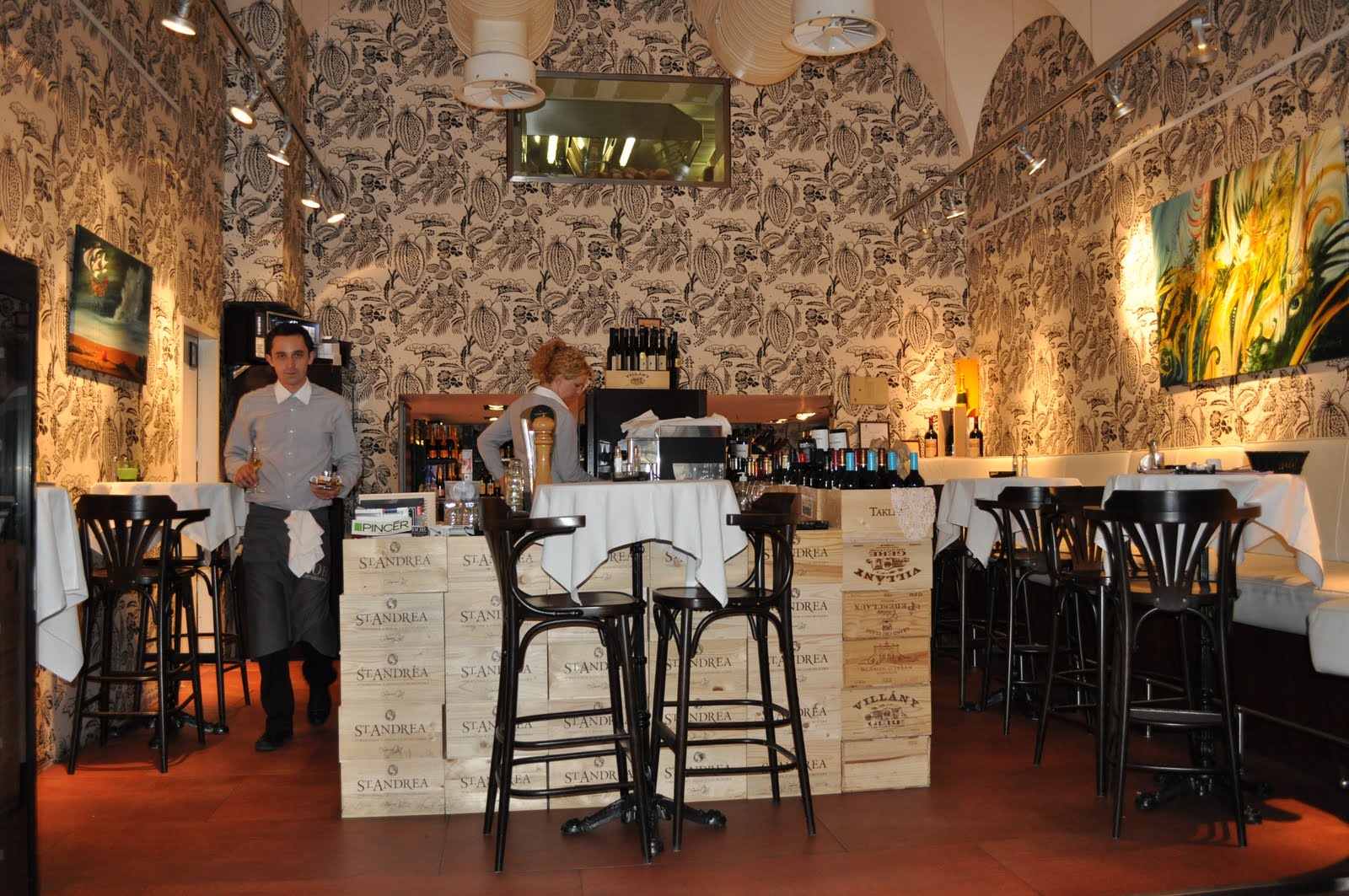
Klassz is the sexy modern restaurant in Budapest, situated on Andrassy Utsa opposite the swish boutiques and a stones throw from the Louis Vitton store, it's decorated with patterned wall paper of the sort that timorous beasties would approve of (though obviously fewer prints of junkies).
Their wine list is short but hits almost every one of the modern and forward looking of Hungarys wine makers, and the menu is, if not cutting edge, then certainly very modern, but with some nice Hungarian accents.

As is my current wont I started with the consommé, served with vegetables, I was a bit concerned when the server brought a bowl along with a copper pan of consomme to the table and the veg looked, well just a little over done, drained a modicum of colour, as if it hadn't quite been chilled quick enough after the first cooking, or if the refreshing wasn't fast enough. However I was quickly disabused of my qualms when I bit into possibly the sweetest tasting piece of green pea, still in it's pod, and frankly still gossiping to it's poddington friends. As I've mentioned earlier I quite like consommes and this carried on the sterling tradition, accessorised with a glass of Bodrog Bormuhely, Lapiz Furmint (Lapiz is a cru just over from Bodrogkisfalud in the southern central part of the Tokaj region) which showed some nice waxy pear and quince with some very tastefully applied barrique influence.

I followed this with breaded Mangaliza, the only acceptable pig breed if you're Hungarian, which came with parsley buttered potatoes, and a stroke of genius in a pickled cucumber and sour cream accompaniment. The delicate sharpness of the pickled cucumber provided a lovely counterpart to the crispy bread-crumbed pork. The meat itself was a nice shade of pink, implying that it had led a good active life, and had more than enough flavour to stand up to what can be quite a brutal style of cooking.
Wanting something light to go with it I had a glass of Heimann Kadarka, now I'm going to write more about Heimann after I visit him on Thursday, but he's one of my favourite growers in the southerly region of Szeksard, and his Kadarka is a treat. Roughly the same body as a Beaune Pinot Noir, it has lovely aromatics of floral cherries and rose petals, with a bitter cherry and licorice on the palette. To my pleasant surprise it was served quite chilled which was perfect on a warmish September afternoon.

I rounded off the meal with an espresso (Riedel glass espresso cup!) and a Plum palinka from Agardi that had seen 4 months in Hungarian oak barriques to give it a touch of body, perfumed, smooth and beautiful.

Klassz isn't perfect, and I suspect that they think slightly higher of themselves than they ought, but that's more a reflection of what else there is aroung in Budapest. However I really like what they are doing, and I'm pretty certain that they're laying down a gauntlet to others. Look at what we're doing, look at what we're charging, now come and match us.

(£25 for starter, mains, two glasses of wine, a coffee and a palinka, of which apart from the main the palinka was the most expensive, service was included)

Highly recommended if you're in Budapest.

Tuesday, 14 September 2010

Consummating a marriage

I remember my Mum recounting to my sister and I a story of how she used to be taken to visit her grandmother for afternoon tea. Before they were allowed to get stuck into the various cakes, tea and sandwiches they were expected to eat a slice of unbuttered brown bread and have a glass of water. This was to show a degree of humility and ensure that they had the proper appreciation for the treats that were in store. This wasn't so far from the war years and rationing was just ending.
I occasionally feel that a nice bowl of consomme does a similar thing at the start of a meal. Made well it can be a kind of thrifty starter, of course if you're going for a real fine dining approach to consomme it can be made with fine meats, but a stock with a bit of extra mirepoix can go a very long way. A little bit of basic clarification leaves you with something quite beautiful, just off clear, with a little sheen of the fats still present just begging to coat your palette and get you ready for dinner.
As starters go it has several great benefits, it's not too filling, so you can usually manage a couple of other courses afterwards. But secondly it's beautiful limpidity means that you can garnish it with all sorts of baby veg which will float appealingly beneath the pale surface. Here in Hungary they're quite fond of cracking a quail egg into it just before service, meaning that it poaches ever so slowly as you eat the soup. Tempting you with it's creamy yolk and ghostly white.
Of course, it's not the most vegetarian of options, but I'm sure a rich vegetarian stock could quite easily be prepared with simple agar clarification, which would please most.
Unfortunately I've found that guests in restaurants where I work often look upon consommes as being a bit of a cop out, too liquid and watery to justify the price of the dish and not dazzling enough in terms of obvious technique (regardless of how much skill goes into their preparation). Which is a shame because I really like them a starter.
Oddly when you look at them they're not so far from the broth base of dishes like Vietnamese Pho which is super fashionable at the moment..... what price tradition? I'd certainly always prefer a good consomme to any amount of foam or excess reduction.