Sunday, 19 September 2010

How we roll in Szekszard country


Szekszard is in the far south of the Hungary and lies about 10km from the Danube, the region itself is really a series of small hills (290 metres being the tallest) and the valleys that interconnect them. The soil tend to be deep loess, occasionally reaching depths of 30/40 metres. This is red wine country, the richness of the soil makes it hard to retain the acidity in the white grapes.

The town itself is a charming little place with a long history. The Romans brought viticulture to the region, and by the 11th century it was important enough for Bela I to found a Benedictine monastery (for the early Christian kings the network of monasteries were an essential part of the modernisation and civilisation of the country), the remains of which can still be seen. The town lies at the foot of the hills, and a short drive is enough to have you in the heart of the region. It's a very friendly and human sized landscape. With houses dotted between the vines, indeed one of the problems the region suffers is the proliferation of hobby growers, small patches of vineyards tended at the weekends by increasingly elderly growers, as the younger generation shows less and less interest in spending their weekends pruning, these are falling into disrepair, particularly problematic as in worse years they are a disease reservoir creating problems for growers nearby. The other issue is that many have small buildings and sheds nestled in the rows. This makes it hard and quite expensive to integrate the vines into larger and better managed holdings.

Viticulturally the region is quite diverse, as mentioned earlier the bulk of the plantings are red varietals, though of the whites Olaz Riesling is the most planted, and I have had nice examples of both Viognier and Czersegi Fuszeres (not a varietal I can see succeeding in the UK market).
Of the reds the traditional Hungarian varietals are Kadarka, Kekfrankos (the same as Blaufrankish from Austria), Zweigelt, and there's some ill advised plantings of Blauburger (a Kekfrankos x Portugeiser) a high yielding and pretty bland crossing. Then there are the international brigade. These are mostly Bordelais varietals, Cabernet Franc leads the pack, with many excellent examples demonstrating that it may well have found a home from home here in southern Hungary (what is it about the Loire getting usurped qualitatively with its prize varietal possessions, it's a bit like the English with sports.... bring them international renown then sit back and watch other countries do them better). There are extensive Merlot and Cabernet Sauvignon plantings too, all three of which are considered classic varietals for the region. Finally some of the more forward looking growers are experimenting with Syrah, and in one case Tannat and Sagrantino.

Like most of Hungary the transition from the Soviet era mindset hasn't been without problems, however the region has been blessed with the irrepressible Zoltan Heimann, currently president of the growers association, which under his leadership has seen the number of growers bottling for themselves grow from about 50 to nearly 200. The Heimanns have been instrumental in raising the quality and renown of the region, and I'm pleased to say that they show no real inclination to stop, further more their son Gabor has recently graduated from Geisenheim and is currently in Tuscany broadening his view of the international wine world.

There are a core of growers that are producing serious wine which stands up very well against international competition, the largest of these would be Takler, though Esterbauer and Vestergombi deserves mentions too. Finally and possibly most interestingly there are a couple of young smaller growers who are generating a lot of excitement with their wines. Csaba Sebestyen and Miclos Palos, though approaching their wine making from slightly different angles are both producing exceptional wines that deserve to be sought out and seen by a wider audience.

Sadly, my time in the region has coincided with possibly the worst vintage of the modern period. Hail in the summer left the vines damaged and rot prone, warm and damp weather sent peronspora raging through the vineyards, often giving growers less than a day to respond, those that hesitated or didn't have good enough canopy management suffered very large crop losses. Frustratingly the well aerated canopies that were necessary to avoid mildew problems also meant that there wasn't that much in the way of leaves, which in turn has meant for many growers what they are harvesting is of a much lower must weight than desired.

The sole mitigating factor is that in the cellars, shielded from all but the most dedicated drops of water there are barrels of the 2009 to taste. 09 was a stunning year for Szekszard, with the only problems was that sugar levels shot up at the end of the summer giving wine makers like Agnes Heimann all sorts of headaches as must weights needed lowering just to get the fermentations started. Indeed Ferenc Takler had to use Veronese yeasts for his Cabernet Sauvignon, only yeasts trained up on Amarone levels of sugar were going to cope and last the distance to the 17% final alcohol levels.

There is a bewildering number of wines and styles produced in this small region. At the entry level there are a host of varietal wines, mostly well made and demonstrative of correct varietal character. The international varietals work well at their respective price points, but aren't really going to set the world on fire. However there are Kekfrankos' that are easily of a level with the very best produced in Austria, I have a soft spot for the slightly difficult Kadarka, and as I mentioned earlier, Cabernet Franc is regularly exceptional. Finally the blends, this is where for me the finest wines lie. From the traditional Bikaver (Bull's Blood) through wines labelled simply as cuvee (hazasitas or birtokbor) to proprietary blends, Heimanns Borbar particularly stands out. There are wines that deserve a wider audience.
A small selection of Szekszard's best wines:

Heimann Viognier 09 – from a northerly slope, stainless steel ferment and no malo ensure that this is fresh as a daisy with lovely pear fruit aromas.

Heimann Barbar 07 – (equal parts Merlot, Tannat, Cabernet Franc with 10% Kekfrankos) this is a wonderfully earthy, ferrous little beast of a wine, sweet red berried fruit, lots of ripe tannins, and then it opens up to reveal violets and spice.

Takler Bartina cuvee 06 – a blend of Kekfrankos, Merlot, Cabernet Sauvignon and Franc with 16 months of new oak, it's a brooding dark and complex wine with blackcurrants, cigar box, spice and is full bodied with copious but ripe tannins.

Sebestyen Pince, Ivan-Volgyi Bikaver 07, a single vineyard Bikaver (50% Kekfrankos, 10% Kadaraka, 25% Merlot and 15% Cab S/F), gorgeously scented dark berries, extremely elegant with beautifully knitted tannins and slight hint of earthiness on the finish.

Palos Miclos Bormuhely, Bodzasi dulo Kekfrankos 07 – full bodied and complex, minerally dark berries, blackcurrants and morello cherries on the nose. Some fresh tannins and an excellent core of acidity keep this direct. The most elegant of 3 very good single vineyard Kekfrankos' that make for a very enlightening horizontal tasting.

It's not team America it's Kadarka Kadarka Kadarka....

Kadarka Kadarka

The legacy of communist era viticulture hangs heavy over Hungary. You can see it in the 4 metre wide rows, built to accommodate the Belarus tractors, in the abandoned hillside vines in Tokaj and the replacement vineyards on the flat land at the foot of the hills. Here in Szekszard you can currently see it at the foot of Zoltan Heimann's Kadarka vines.
2010 will not be remembered fondly by the Heimanns (and not just because they met me), 9/10ths of the crop lies on the floor, too rotten or too unripe to be picked. The remainder is being pressed quickly to get the juice of the skins and will, after some chaptalisation, go into their rose blend. There won't be a Heimann Kadarka 2010. They have a clone called P9 planted, it was the popular thing to plant during the Communist era when growers were organised into collective units and cooperative farms. The Soviet block countries decided what they were going to pay for wine by volume and it was through this that the wine growers received their payment. This meant that there was absolutely no accounting for quality. The desire was for easy clones that produced big, big yields (incidentally this explains the otherwise inexplicable existence of Blauberger).

Back at the Heimann estate, we're in his experimental Kadarka block, some years ago he went round the region and collected cuttings from blocks like that of 90-105 year old Kadarka plants owned by the Csaladi Birbitok. It's immediately clear just how poor the P9 clone is, it's large bunches ripening unevenly and the large thin skinned succumbing to grey rot at the first sign of rain. Reverse engineering better clonal diversity and relearning the genetic potential of ancient vines is not a quick project (about 15 years in Tuscany), however Zoltan hopes to have the first wines in 2012. After which it'll be a very slow process as vineyards are replaced with better stock.
P9 Kadarja grapes

Unsurprisingly given it's thin skin, it's a difficult vine to work with, in the winery it tends towards a slightly reductive ferment, so it is usually worked with in open top tanks, due to the thin skin extraction has to be done carefully as too much will result in tannins from the pips muddying the wine.

Talking to the winemaker from Verstergombi he tells me that at the end of the 18th century Kadarka comprised some 90% of the regions plantings and that there were always 3 different wines made. A white version (see Meszaros), a red similar to that made commonly now and an Aszu version. Along with this he also mentioned that it was ideal to get somewhere in the region of 15% botrytised grapes for the red. His assertion was that this didn't affect the colour of the wine, but merely added a glycerol rich, higher sugar content to the final wine. I'm not sure whether I believe this, but I'll print it anyway...

In large tastings it can be easy to miss the charms of Kadarka, I know I failed to really appreciate it for some time, it's not a big wine, and doesn't really work that well with oak. However at it's best it's an incredibly charming sort of wine. A slightly shy girl next door to Pinot Noirs often surly cat walk model. She might not be the one that you lust after and probably won't be a cover star any time soon but that shouldn't stop you from keeping an eye out for a bottle. It shouldn't dissapoint.

A snap shot of Szekszard's Kadarkas:

Franther Pincezet 09, this was a surprise as I wasn't blown away by the rest of their wines, however their Kadarka was a treat, super ripe with a lovely liqorous wild strawberry nose and lifted red fruits, nice acidity and like the other 09's I had the pleasure of trying it had a great fullness of body on the palette. One of the best I tasted.

The Heimann's 08 show's a floral red cherry nose, it was served beautifully chilled at Klassz and had a toothsome bitter cherry character on the body with a touch of licorice on the finish.
The 09 (bottled but not released) was similar on the nose but possessed of richer more liqorous character on the palette.

Sebestyen Pince (one of the highly regarded younger growers) has mixed old and new vines with P9 as the newer planting, his Kadarka release is called Selection and this covers both parcels and barrels. It's an excellent wine with a full bodied, meaty spiced red berry nose, a little bit of oak character on the palette fleshes out a bitter dark chocolate and cherry palette.

Vestergombi, they have an 8 yr old block of Kadarka, though they weren't sure what clone had been planted, the ferment was 24-26 degrees centigrade and extraction was via remontage. The wine had a delicate floral redcurrent nose and had a odd ever so slightly stalky note on the palette.

Esterbauer have a mixed planting with older vines bringing richness to the final wine, they are famous domestically for their Kadarka, their 09 was fermented in old wood then moved to steel and had a lightly spiced red berry nose, with strawberries, raspberry and some bitter cherry. On the palette there was a nice coffee infused bitter cherry sort of fruit.

Csaladi Borbitok, Vida 07, this showed a sort of sweaty red berry and pepper nose. Some slightly rustic tannins and an odd lack of freshness. Strangely this reminded me of tasting Pinot d'Aunis from the Coteaux de Loir. Enquiring a bit further, it's mentioned Csaladi Borbitok are known for a bit of over extraction, and this showed in their other wines too.

Takler have two blocks of Kadarka, one was planted about 10yrs ago the other date from the 1950's, however they too are looking to make a massale selection of 90-95 year old vines, their 08 had a delightful medicinal rosehip nose and similar camphor licked red berry palette.

Fritz Borhaz 08, was rosehip and bramble scented, light bodied with light weight tannins at the finish.

Markvart 08, this was very pale with a spiced orange peel and bramble fruits, there was a slight confected character to it too.

Aranyfurt Mezogazdasagi KFT (a 20 grower coop) 08, very light and a little watery, with an ok strawberry and rosehip nose.

Meszaros, St Gral 07 Meszi Kadarka, named after the winemakers nickname (Meszi – sounds a bit like Mezig, for those that worked at le Breton), this had been matured in oak which sadly obscured the delicate charm of the floral fruity Kadarka nose.

And for completeness I'll mention the Feher Kadarka 09 from Meszaros. Despite my translator insisting that the skins were removed manually before pressing (I though she was taking the piss, she wasn't) this is a gentle blanc de noir style of wine, and despite being a lovely idea, it had the most peculiar nose (I'm being polite) and was of dry on the palette. I'm told this is made every year, which suggests that it sells, quite how I don't know..

Wednesday, 15 September 2010

A Klasse Act

Modern Hungarian cuisine..

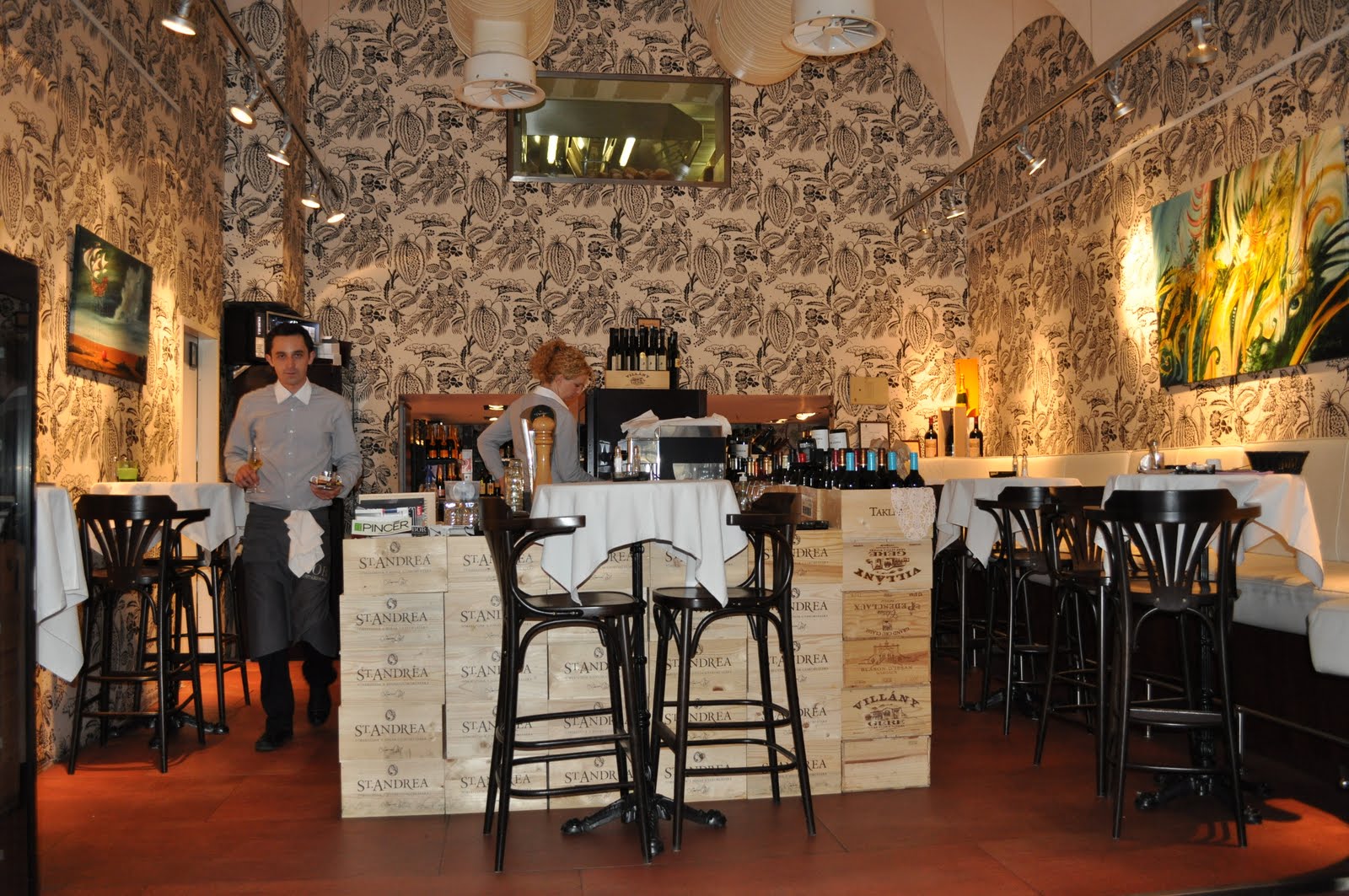
Klassz is the sexy modern restaurant in Budapest, situated on Andrassy Utsa opposite the swish boutiques and a stones throw from the Louis Vitton store, it's decorated with patterned wall paper of the sort that timorous beasties would approve of (though obviously fewer prints of junkies).
Their wine list is short but hits almost every one of the modern and forward looking of Hungarys wine makers, and the menu is, if not cutting edge, then certainly very modern, but with some nice Hungarian accents.

As is my current wont I started with the consommé, served with vegetables, I was a bit concerned when the server brought a bowl along with a copper pan of consomme to the table and the veg looked, well just a little over done, drained a modicum of colour, as if it hadn't quite been chilled quick enough after the first cooking, or if the refreshing wasn't fast enough. However I was quickly disabused of my qualms when I bit into possibly the sweetest tasting piece of green pea, still in it's pod, and frankly still gossiping to it's poddington friends. As I've mentioned earlier I quite like consommes and this carried on the sterling tradition, accessorised with a glass of Bodrog Bormuhely, Lapiz Furmint (Lapiz is a cru just over from Bodrogkisfalud in the southern central part of the Tokaj region) which showed some nice waxy pear and quince with some very tastefully applied barrique influence.

I followed this with breaded Mangaliza, the only acceptable pig breed if you're Hungarian, which came with parsley buttered potatoes, and a stroke of genius in a pickled cucumber and sour cream accompaniment. The delicate sharpness of the pickled cucumber provided a lovely counterpart to the crispy bread-crumbed pork. The meat itself was a nice shade of pink, implying that it had led a good active life, and had more than enough flavour to stand up to what can be quite a brutal style of cooking.
Wanting something light to go with it I had a glass of Heimann Kadarka, now I'm going to write more about Heimann after I visit him on Thursday, but he's one of my favourite growers in the southerly region of Szeksard, and his Kadarka is a treat. Roughly the same body as a Beaune Pinot Noir, it has lovely aromatics of floral cherries and rose petals, with a bitter cherry and licorice on the palette. To my pleasant surprise it was served quite chilled which was perfect on a warmish September afternoon.

I rounded off the meal with an espresso (Riedel glass espresso cup!) and a Plum palinka from Agardi that had seen 4 months in Hungarian oak barriques to give it a touch of body, perfumed, smooth and beautiful.

Klassz isn't perfect, and I suspect that they think slightly higher of themselves than they ought, but that's more a reflection of what else there is aroung in Budapest. However I really like what they are doing, and I'm pretty certain that they're laying down a gauntlet to others. Look at what we're doing, look at what we're charging, now come and match us.

(£25 for starter, mains, two glasses of wine, a coffee and a palinka, of which apart from the main the palinka was the most expensive, service was included)

Highly recommended if you're in Budapest.

Tuesday, 14 September 2010

Consummating a marriage

I remember my Mum recounting to my sister and I a story of how she used to be taken to visit her grandmother for afternoon tea. Before they were allowed to get stuck into the various cakes, tea and sandwiches they were expected to eat a slice of unbuttered brown bread and have a glass of water. This was to show a degree of humility and ensure that they had the proper appreciation for the treats that were in store. This wasn't so far from the war years and rationing was just ending.
I occasionally feel that a nice bowl of consomme does a similar thing at the start of a meal. Made well it can be a kind of thrifty starter, of course if you're going for a real fine dining approach to consomme it can be made with fine meats, but a stock with a bit of extra mirepoix can go a very long way. A little bit of basic clarification leaves you with something quite beautiful, just off clear, with a little sheen of the fats still present just begging to coat your palette and get you ready for dinner.
As starters go it has several great benefits, it's not too filling, so you can usually manage a couple of other courses afterwards. But secondly it's beautiful limpidity means that you can garnish it with all sorts of baby veg which will float appealingly beneath the pale surface. Here in Hungary they're quite fond of cracking a quail egg into it just before service, meaning that it poaches ever so slowly as you eat the soup. Tempting you with it's creamy yolk and ghostly white.
Of course, it's not the most vegetarian of options, but I'm sure a rich vegetarian stock could quite easily be prepared with simple agar clarification, which would please most.
Unfortunately I've found that guests in restaurants where I work often look upon consommes as being a bit of a cop out, too liquid and watery to justify the price of the dish and not dazzling enough in terms of obvious technique (regardless of how much skill goes into their preparation). Which is a shame because I really like them a starter.
Oddly when you look at them they're not so far from the broth base of dishes like Vietnamese Pho which is super fashionable at the moment..... what price tradition? I'd certainly always prefer a good consomme to any amount of foam or excess reduction.

The Sheep Pig

Spending a bit of time wandering around Budapest and looking at restaurant menus, certain things become clear. They're quite proud (rightly so) of a good Goulas, they like their hot peppers and paprika, and as far as they're concerned there is only one true pig and that is the Mangaliza, a little bit of research tells me (thank you google translate) that roughly trasnslates as Sheep-Pig which readers of a certain age (I'm told there is a film, but I stubbornly refuse to have my youthful imagination defiled by Disney) will fondly recall as a book by the estimable Dick King-Smith.
I'm told that they were regarded as the main variety of pig in Hungary from the time of their first breeding, some 200 years ago, until the arrival of collectivist farming practices which meant that British cross breeds were imported as they produced more flesh and less fat. However with the collapse of the Communist regime people started to breed them again (It's amazing how many good things about Hungary were reborn 20yrs ago..), and now they are quite common.
They grow a thick layer of subcutaneous fat which, rather like blubber, helps to keep them warm during the tough central eastern European winters, meaning that they can survive the whole year outside, perfect for small holders in times gone by.
Apparently they're very docile, and can become accustomed to human contact quite easily. On a far less serious note they look very cute.
So we have one more task on the list, track down some Mangalizas.....

Platan restaurant and lake Tata


Tata..

A lazy Sunday afternoon out in the country was how it was sold to me. Get the train out to a village near to where Gergely grew up, I could get a little insight into why he is like he is, or something. Any way far more importantly we were taking his mum out to Lunch.
Tata is about an hour out of Budapest by train, it's a nice journey, you leave the outskirts of Budapest pretty quickly and from then on it's gently rolling hills which at the tail end of summer are all a lush verdant green.
Arriving at the village we stopped just outside of quite a marvellous ruined castle. Originally built in Roman times, but was renovated in the Renaissance style by Matthias 1st. The castle is surrounded on 3 sides by a large moat and a lake, with a steep rocky side on the other, so it was a major fortification, holding out in most cases until the Habsbergs torched it in retaliation for Rakocsi Ferenc's revolution.
Wandering through the ruins brings you to the edge of the lake. As the lake is drained into the Danube it is surrounded by canals and streams which flow away like strands on a spiders web, many of these were used by mill houses, so the lake is adorned with many examples of these beautiful buildings.

The restaurant we were visiting was a surprise, Norbert the manager has spent many years around the Hungarian wine scene, opening Budapest's first serious wine bar before moving on to be an F and B manager at a 5* hotel. Platan is genuinely his baby. There is a seriously equipped kitchen, restaurant, heated terrace, pattiserie and lakeside seating area. In the summer they have live jazz and poetry readings, there is a floating stage that they moor just off the edge of the lake, and I imagine that spending an evening with a couple of glasses of Palinka would be quite something.

They're approach to their food is as about as on message as you could get (barring lots of small plats, they tried this and found that the large number of tourists didn't like it, so it's proper portions all the way). Everything is seasonal, when we were there there was a wild mushroom menu that will run until the chef feels that their getting a bit dry and wintry, then there will be the fishing festival when the lake is partially drained and the carp are caught.
They have a private 8ha area of woodland where they can source their game, including proper wild boars. They have a small private lake where they breed fish other than carp, and just to add icing to the cake they have a cattle breeding program that now after one and a half years of setting up provides them with a 3 week old milk fed veal calf every fortnight. Now I've spoken to chefs who are serious about sourcing their ingredients but this is one step better.
As I was feeling a little bit delicate I opted for the chicken broth with vegetables and quail eggs and it was exactly what I needed, excellent depth of flavour and full of very fresh baby veg, my only slight quibble was that the egg was hard boiled, where I prefer them to be dropped into the broth raw so they cook very slowly and are all lovely and runny.
This was followed by 'friable' rump of beef, I initially though that this was a spelling mistake as friability is something I associate with rocks and soil science, but it was effectively pot au feu, again beautifully done, served with a reduced version of the cooking liquor, lots (lots) of vegetables and several large crouts smothered in marrow.
The cooking was all excellent and done with a firm grasp of traditional dishes, but rather like modern bistro takes on French classics there was a focus to them that is probably lacking from the originals.
We finished with a summer plum cake, coffee and a raspberry palinka on the terrace gazing contentedly out towards the lake.

After lunch we went for a stroll round the lake taking in such bizarre sights as the gate of lovers padlocks, apparently when couple get engaged they lock a padlock onto the gate and throw the key into the lake as a sign of devotion. I guess it beats carving a heart and initials into a tree.

Then we arrived at the English Gardens, built by the Esterhazy family who had been very well travelled and was inspired by the landscaped gardens of the English aristocracy, taking in another small lake with grottoes and a lovely fake ruin, apparently they bought up a load of old ruins including that of an old abbey and had them moved into the garden to add character. A nice little touch.

Monday, 13 September 2010

Champagne or the Emperor Strikes Back


Gyropalettes at Lombard et Medet, looking for all the world like something you'd find at a US military base.... one side aimed at Cava the other at Prossecco maybe?